How do you know if your GenAI-powered applications are safe and compliant?
Key takeaways
- GenAI introduces a new category of unpredictable uncertainty that traditional compliance playbooks were not built to handle.
- Proving that an application stays within acceptable risk boundaries is difficult when models can give different answers to the same question twice.
- Security and governance leaders often lack the tools to answer if testing repetition is sufficient or if model changes have caused safety regressions.
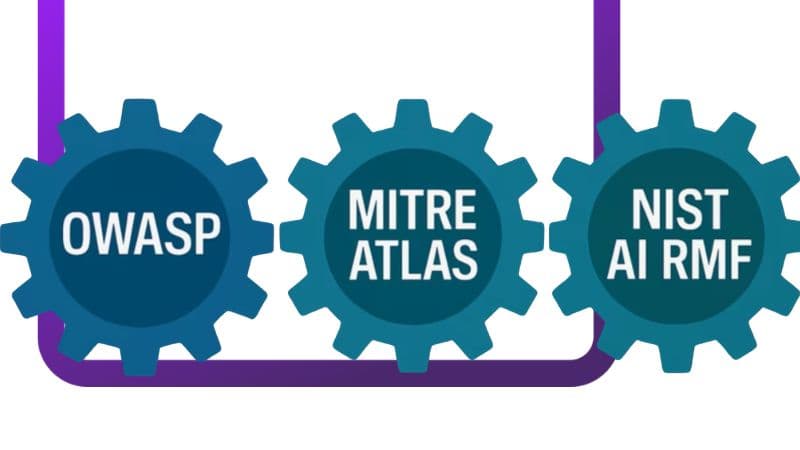
- Industry-standard frameworks like NIST AI RMF, MITRE ATLAS and the OWASP Top 10 provide the necessary blueprints for strategic governance and tactical defense.
- Fuel iX™ Fortify automates the mapping of AI interactions to these frameworks to replace manual spreadsheets with continuous audit-ready evidence.
- This automated approach transforms technical risks into a single source of truth that provides defensible proof of resilience for both developers and board members.
"Sign here to certify this GenAI is safe."
If that sentence makes your stomach drop, you’re not alone. As a CISO, responsible AI, compliance or governance leader, you’re being asked to vouch for something that is — by design — unpredictable. GenAI doesn’t just introduce new risks; it introduces a new category of uncertainty that traditional compliance playbooks weren't built to handle.
Defining "acceptable risk" may be uncertain terrain. However, proving you’re staying within those boundaries when your GenAI might give a different answer to the same question twice is uncharted territory.
- How do you determine if you are conducting sufficient testing repetition to understand the likelihood of response variability that might tread into unsafe behavior?
- How do you know if you are covering the breadth of risks that are introduced by the GenAI attack surface area?
- How do you know if the techniques used in testing are sufficient to identify vulnerabilities?
- How do you know if an application deemed “safe” during one testing cycle has regressed due to model, guardrail or system prompt changes?
These are questions that security, governance and risk leaders typically cannot answer.
So, where does that leave us?
The good news is you don’t have to become an expert in every emerging AI threat or spend weeks deciding which risks matter most. Leading standards and research organizations have established guidelines for what to test and how to mitigate specific risks. TELUS Digital has automated the process of AI safety testing and validation that maps to these guidelines.
Fuel iX™ Fortify is an automated AI safety and security platform that continuously tests GenAI applications for vulnerabilities and maps risks directly to industry-standard frameworks like OWASP, MITRE ATLAS and NIST.
As Hyrum Anderson, Sr. Director of AI & Security at Cisco, notes: "The OWASP Top 10 for Agentic Applications is grounded in deep technical analysis and broad industry collaboration. The rigor behind this list provides more than a summary of concerns — it's a thoroughly validated foundation you can safely anchor your security attention to."
Three pillars of trust
TELUS Digital has witnessed the reality of AI governance and risk validation today: everyone agrees we need it, but everyone involved speaks a different language. Developers talk about prompt injection. Board members talk about liability. Responsible AI leaders talk about safety. Auditors talk about documentation gaps. CISO’s talk about security. The different use of language also clouds another issue. Each of these constituencies tends to overindex on some elements of AI safety and security and under indexes on others.
Three organizations are helping transform technical noise into boardroom clarity. Whether they are called risk frameworks or verification standards, they are guides for helping executives know whether they can trust the status of their GenAI-enabled solutions and where they need to take action and mitigate risk. Mapping adversarial testing results to these guides is challenging and time-consuming. Fortify embedded them as an automated classification that is a natural byproduct of the testing and monitoring processes.
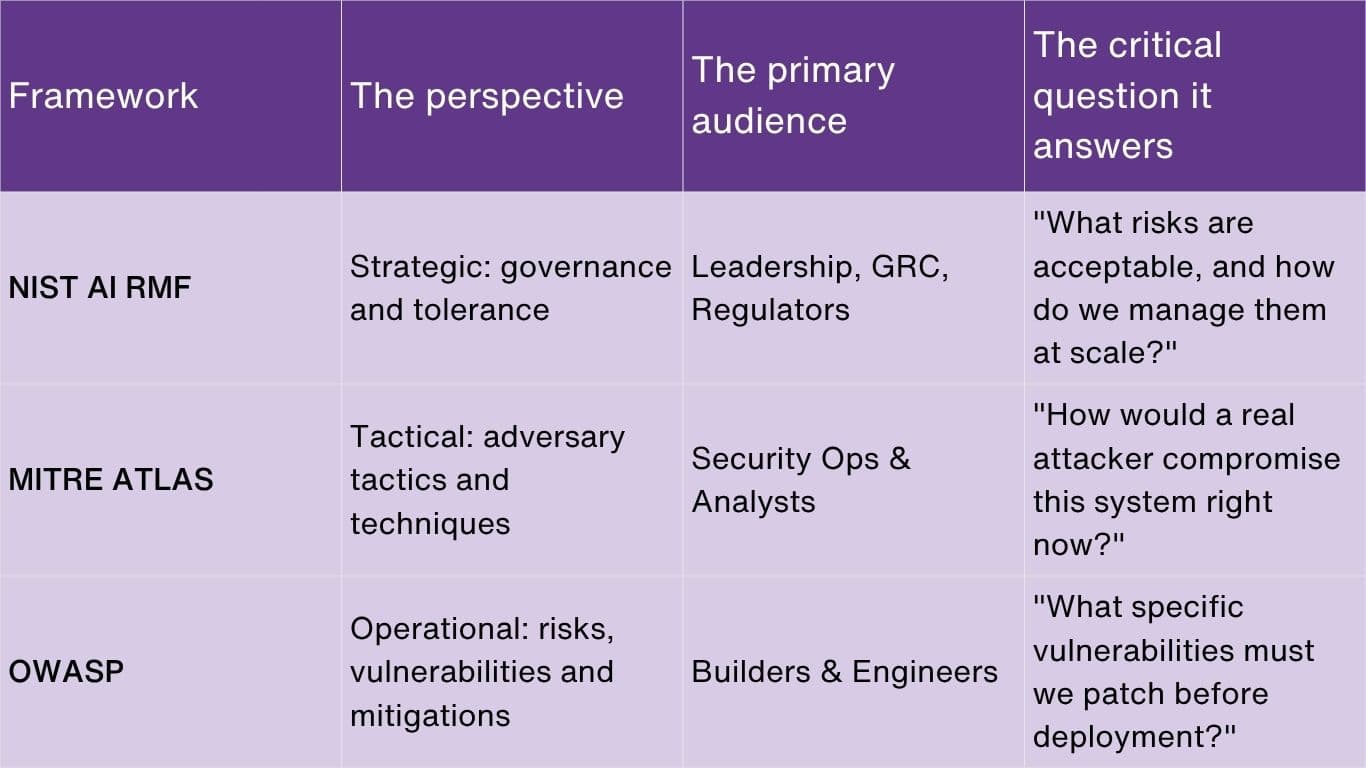
1. NIST AI RMF – "The strategic blueprint"
NIST gives you the vocabulary to answer the question every board asks: "How do we know this won't blow up in our faces?" It isn’t just a list of controls; it’s your high-level playbook for managing enterprise risk tolerance and responsible AI at scale.
2. MITRE ATLAS – "The adversary's playbook"
MITRE takes the legendary ATT&CK matrix and applies it to AI — mapping over 200 real-world attack techniques. When a stakeholder asks, "How would a hacker actually break this?"— MITRE provides the forensic answer.
3. OWASP Top 10 for LLMs – "The developer's field manual"
OWASP is the global standard for LLM application security. The engineering teams' clear checklist answers the question, "What exactly do we test before this goes live?"
Risk management frameworks
From "spreadsheet hell" to automated evidence
Understanding the significance of these frameworks is the first challenge. Applying them and monitoring progress is harder.
Most organizations are stuck in spreadsheet hell — manually mapping penetration test findings to standards, arguing over severity and hoping they didn't miss a critical vulnerability. In the world of AI, by the time you’ve documented last month's vulnerabilities, new ones have emerged, which means testing and mapping to frameworks begins again.
Fortify: Powering up the governance engine
Fortify doesn’t just check boxes — it builds your audit trail as it tests and monitors.
It creates a "governance wrapper" around your AI, automatically mapping every interaction to OWASP, MITRE ATLAS and NIST AI RMF at the attack session level. No manual translation. No "we’ll document that later." Just continuous, standardized proof of resilience.
Here’s how Fortify translates technical chaos into boardroom confidence across the four dimensions that keep CISOs up at night:

From black box to defensible proof
GenAI will always have an element of unpredictability, but unpredictability doesn’t have to mean ungovernable.
Fortify transforms your GenAI from a compliance liability into a measurable, audit-ready asset. You don’t need to become an expert in 140+ attack types or chase every framework update. Fortify continuously measures your resilience against your specific risk tolerance, giving you the one thing every CISO and GRC expert needs: defensible proof.
Whether you’re a developer patching a vulnerability or a CISO facing the Audit Committee, you finally have a single source of truth for AI trust.
Ready to automate your governance?
Watch how specific AI vulnerabilities map to NIST, MITRE and OWASP in real-time.