The smart discounting playbook: How to match offers to customer value and intent

Anne Williams
Senior Digital Marketing Manager

Key takeaways
- Mass-market discounting is a margin-killer. Treating your entire database as a monolith leads to revenue cannibalization by over-discounting customers who were already prepared to buy at full price.
- A successful discounting strategy must be self-correcting. The surge in purchase volume must significantly outweigh the dip in net price to ensure your bottom line remains protected.
- Moving from mass offers to behavioral personalization allows you to align deals with specific customer triggers, ensuring your promotions feel like relevant rewards rather than desperate noise.
- Transitioning to a personalized model doesn't have to drain team resources. Intelligent automation allows brands to execute complex, real-time discounting workflows and dynamic pricing strategies without increasing operational overhead.
Deploying deals is one of the most powerful tools in your loyalty program, but without strategic personalization of deals and their discount rates, brands are leaving money on the table. Every customer has a different average order value, lifecycle status, purchase frequency and product preferences. Relying on generic, mass-market deals ignores the unique data signals your customers are sending.
However, it can be much easier on your marketing team’s time and resources to create a mass-appeal library of “% off,” “$ off,” BOGO, “buy X, get Y” and points accelerator deals that cover a spectrum of products. That’s the “deal dilemma,” where brands trade long-term profitability for short-term spikes.
To protect your margins in a value-conscious market, it’s time to move beyond reactive markdowns and master a two-tiered approach to discounting that balances behavioral triggers with predictive precision.
The cost of one-size-fits-all offers
Many loyalty programs deploy batch-and-blast offers to their loyalty customers, but treating a diverse customer base as a monolith often leads to a race to the bottom that erodes brand value and shrinks margins. By sending everyone a “% off” deal on ‘product A’ with a high discount rate, a brand would be overdiscounting users who would have purchased that product anyway without a discount.
At the same time, that brand is not appealing to customers who simply don’t like, want or need product A. To be truly effective, a discount must trigger enough incremental purchase volume to offset the loss in per-unit margin. If the surge in sales doesn't significantly outpace the dip in net price, you're simply subsidizing purchases that would have happened anyway. Fortunately, there’s a better way to send the right deal to the right user, with the right discount rate.
Level one: Behavioral personalization
Transitioning away from static, mass-market offers begins with segmenting your audience based on demonstrated behaviors rather than just demographics. We’ll use a salad restaurant brand to exemplify how this works.
Average order value
Personalizing deals by average order value (AOV) is a level-one personalization tactic. The first step is to segment customers into AOV tiers, identifying who is a big spender and who buys a minimal amount in a program.
In our salad restaurant example, our customer segments are:
- Low AOV: $0-10
- Medium AOV: $10-15
- High AOV: $15+
Next, segment discount ranges into three tiers, from lowest to highest. Using the AOV segments, we can make some assumptions about what will motivate each to purchase.
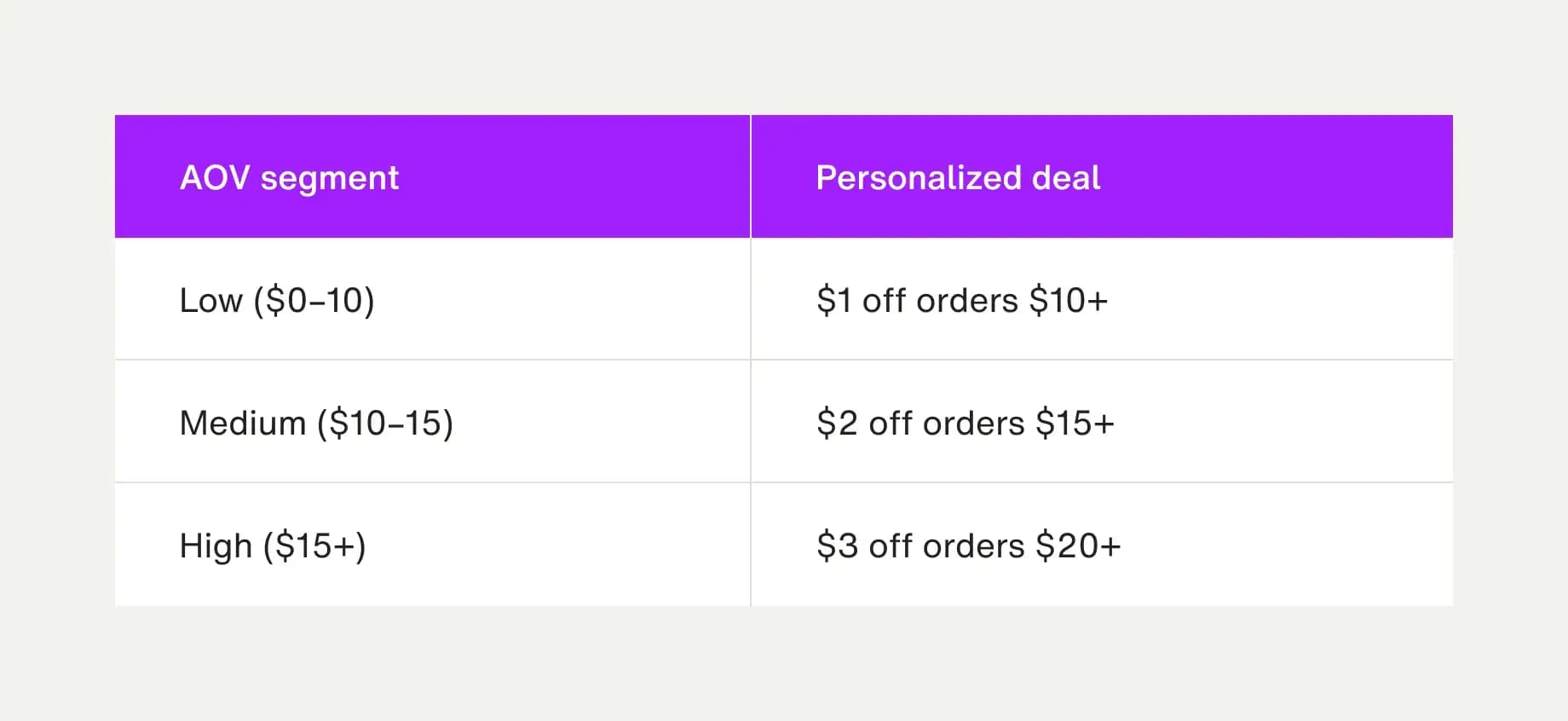
If a customer is in the highest tier ($15+), they're unlikely to respond well to deals with a $5 or $10 spend threshold. It doesn’t match their buying behavior or incentivize them to add one additional item to their purchase to increase their average check size.
Previously, this brand would have sent an offer for “$1 off a $10+ purchase” to the entire audience. But with AOV segments, that deal will be personalized to the right group.
Most purchased item
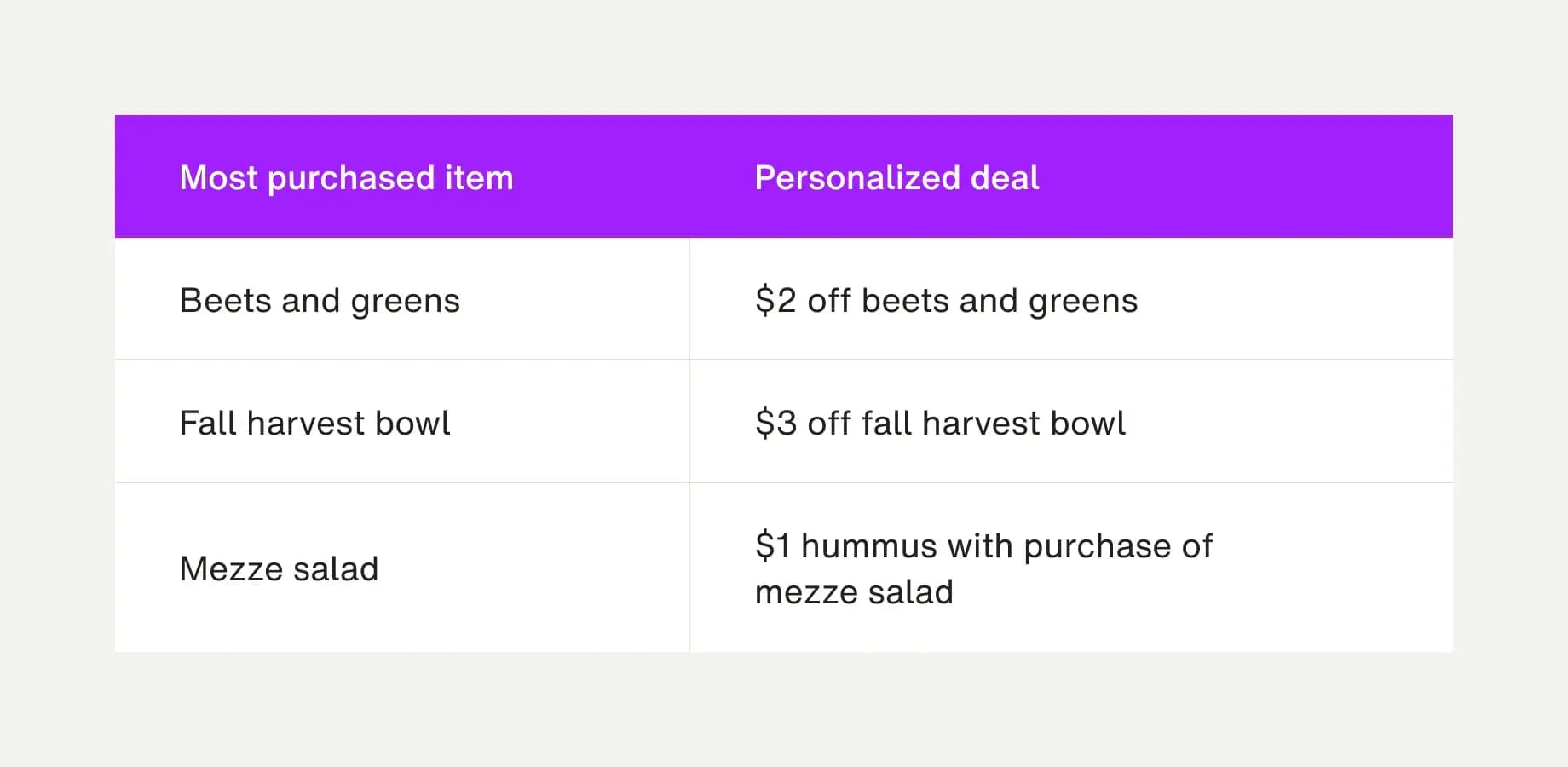
Another type of behavioral personalization is product affinity, which requires segmenting customers into top product affinities (starting with the most popular by quantity purchased) to create “most purchased item” segments.
In our salad restaurant example, our “most purchased item” segments are:
- Beets and greens
- Fall harvest bowl
- Mezze salad
Previously, this restaurant brand would have sent mass deals to all loyalty members for various products throughout the month, but using “most purchased item” segments, they can create more effective deals.
Level two: Predictive personalization
By completing level one, your brand begins deploying deals that feel relevant to each user, and you should see boosted redemption rates, purchase frequency and total transactions.
Advancing to level two transforms your strategy from observation to anticipation. By integrating predictive analytics into your level-one framework, you can move beyond general segmentation to personalize the specific discount structure for every user — ensuring your incentives are as dynamic as the customers receiving them.
Many customer data platforms (CDPs) use AI to forecast customer behavior and identify the users most likely to convert within a given time period. CDPs such as mParticle and Segment use machine learning to intake a variety of customer behaviors (browse the app, view product page, make purchases, sign up, sign in, etc.) and assign a “likelihood to purchase” score. This score is the best indicator of who does and who doesn't need a large incentive to buy from your brand.
By using a “likelihood to purchase” model, a brand can take their existing level-one personalized deals and apply smart discount rates to create optimized deals.
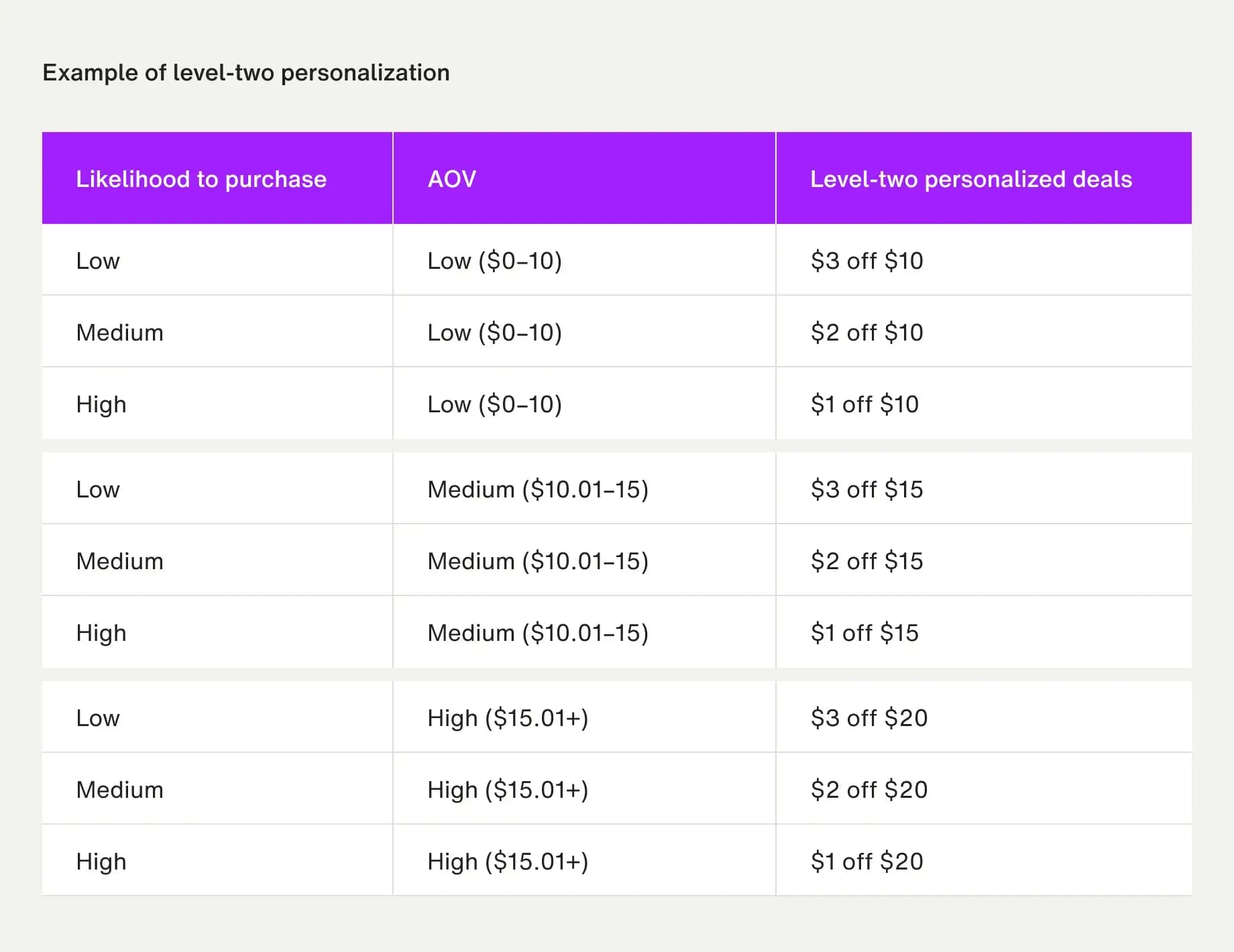
Over-discounting to customers who would purchase anyway amounts to revenue cannibalization. Instead, reserve deeper discounts for customers who need the incentive to convert, and give loyal, high-propensity customers recognition, exclusivity or minimal discounts that protect your margins while maintaining their goodwill.
From manual effort to automated growth
While the transition from mass offers to predictive, multilevel personalization can be an operational hurdle, integrating intelligent automation removes the burden of nuanced discounting from your team. By leveraging automated decisioning engines, your brand can execute these complex workflows in real-time — ensuring the right deal reaches the right user at the precise moment of intent.
Interested in learning more about how TELUS Digital’s loyalty team can help your brand reach its loyalty goals? Learn more about our loyalty program design services.