Mastering conversation design in the age of AI-powered CX

Elizabeth McCoy
Senior Program Director
Robbie McCown
Senior Design Director
Connor Harrison
Senior Content Designer

Key takeaways
- Conversation design has evolved beyond simple “if-then” rules to agentic experiences — AI doesn't just respond; it autonomously identifies goals from conversations and then executes complex tasks across multiple systems.
- Successful adoption of conversational AI tools (like those used in clinical research) depends on mapping brand guidelines to research-backed principles such as transparency, behavioral empathy and objectivity to build user trust.
- Designing for neurodiversity is a strategic priority, not an edge case. By reducing cognitive load and simplifying flows for neurodivergent users, brands create a more intuitive, high-performing experience for everyone.
- As conversational AI scales, an evaluation model powered by human-in-the-loop review is essential to efficiently stress-test robustness while maintaining safety and brand alignment.
The field of conversation design is growing rapidly as AI and voice adoption converge, driving consumer demand for conversational experiences that feel personal, helpful and intuitive. For customer experience (CX) directors, product managers and innovation leaders, this growing demand means:
- Building new solutions based on responsible conversation design principles
- Updating legacy conversation interfaces to meet modern user expectations
The competition to be customers’ go-to conversational tool is fierce, too. Companies dedicate entire ad campaigns focused on their products’ voice capabilities, from celebrities having open-ended conversations with Amazon Alexa to Microsoft dubbing its Copilot PCs “the computer you can talk to.”
With this surge in innovation and competition around conversational experiences, it’s important to understand what conversation design is, how it supports the full CX journey and why it matters now more than ever.
What is conversation design?
Conversation design is the practice of creating natural, intuitive and helpful interactions between humans and chatbots, voice assistants and other conversational interfaces. Instead of focusing on links, buttons and other controls, conversation design treats language itself as the interface, requiring systems to interpret intent, context and nuance in real time.
As AI systems become more agentic, conversation design is shifting from just scripting responses to playing a more central role in shaping autonomous behavior, including how users set goals, build trust and initiate action across systems.
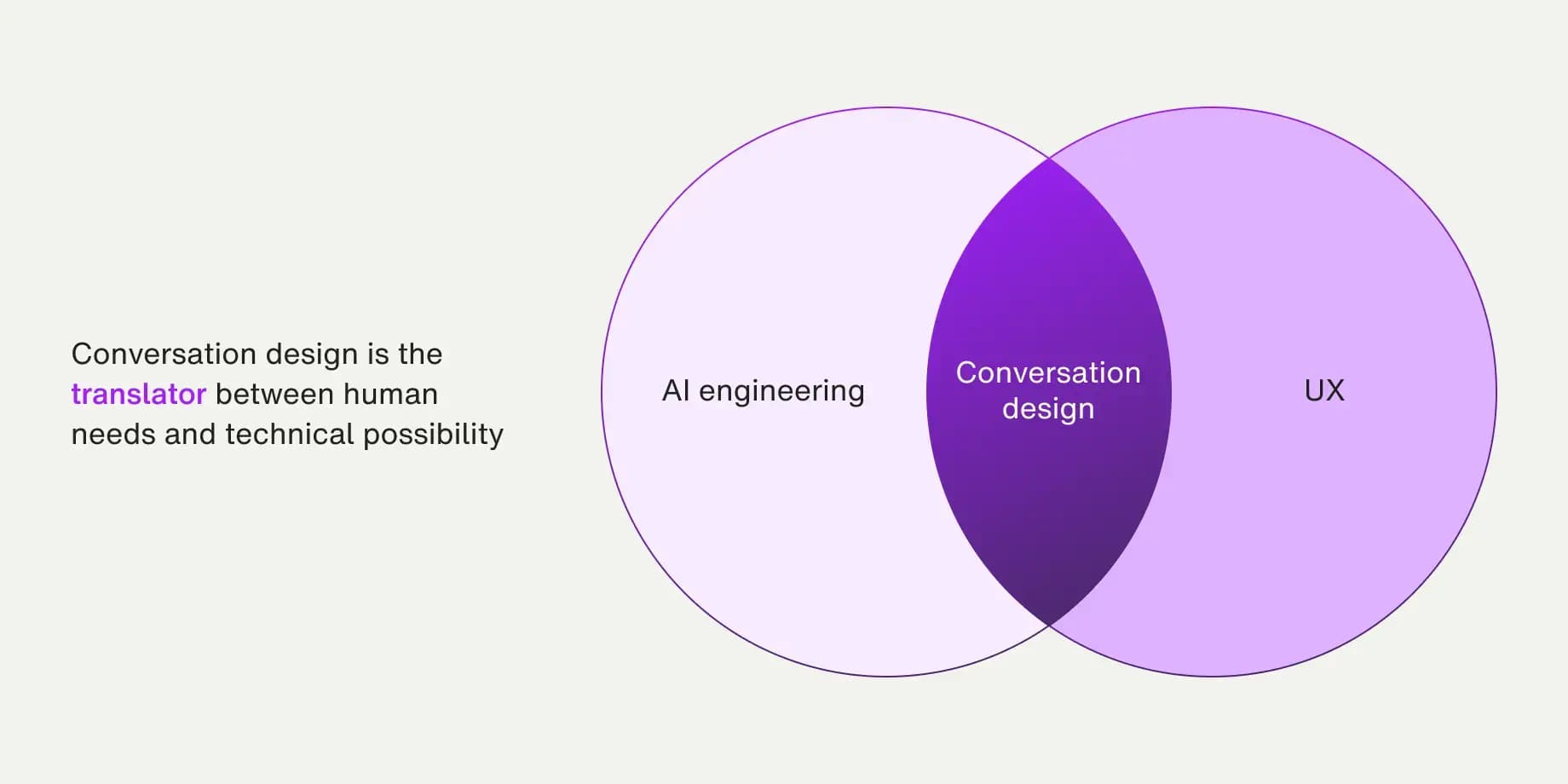
To create those natural, intuitive and helpful interactions, conversation designers bring together a unique intersection of creative and technical skills, including:
- AI model training
- Prompt design
- UX and technical writing
Cross-functionally, conversation designers collaborate with teams like research, strategy and engineering to understand user personas and user journeys. That understanding, combined with the technical realities of the project (e.g., training an AI model for a voice user interface vs. writing scripts for an interactive voice response system), guides the design of conversation flows.
The table below illustrates the rapid advancement of conversation-based products, comparing the dominant forms of conversation design from just a decade or so ago with those of today.
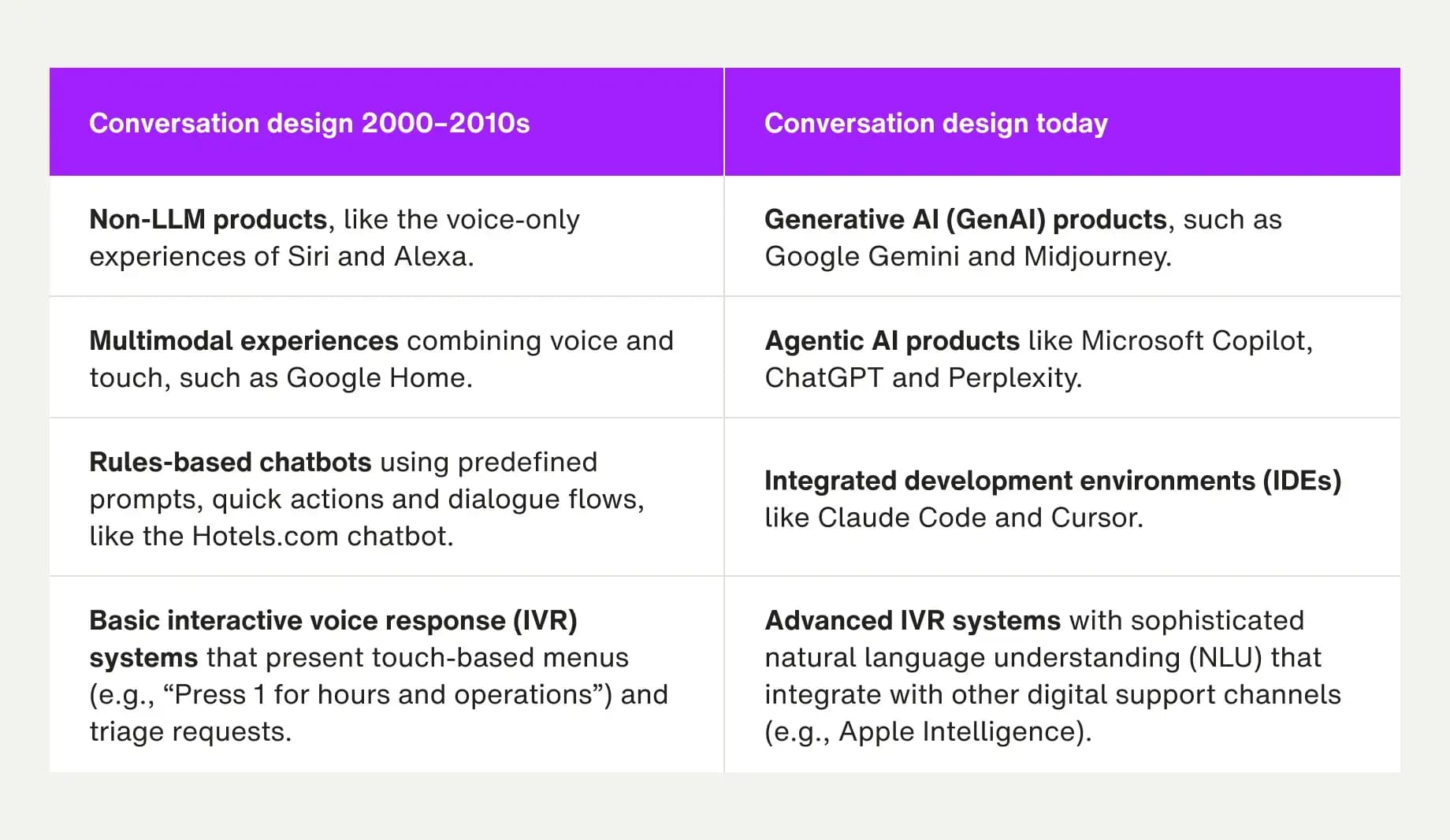
The more brands invest in CX solutions built on generative and agentic AI like those in the table above, the more integral conversation design becomes to winning the moments that matter in the customer journey.
What are the three main types of conversation design?
Conversation design breaks down into three types that utilize different technologies:
- Rules-based
- Generative
- Agentic
Each type of conversation design offers a different level of sophistication, but that doesn’t mean the most sophisticated (i.e., agentic) is the best by default. Ultimately, the best form of conversation design is the one that best serves your solution.
Reporting road hazards to Waze while driving, for instance, is a different conversational experience than booking an appointment through a customer service chatbot. Likewise, building a conversational AI assistant for financial services requires navigating more regulations and security threats compared to developing an end-to-end shopping assistant.
Rules-based
Rules-based conversation design operates on a set of hard-coded if-then rules created by human programmers. Rules-based conversations are completely predictable and cannot handle any situation that hasn't been explicitly programmed for.
Example: A simple chatbot that responds to the word “hours” with the company’s hours of operation. If a user asked instead, “When are you open?” the chatbot wouldn’t understand unless a specific rule for that phrasing had been programmed.
Generative
Generative conversation design creates new original content (e.g., text, images, music, code) by learning patterns, structures and styles from massive datasets.
Example: Asking a tool like ChatGPT to summarize complex, lengthy procedural documents, or prompting Midjourney to create carousel images for a social media campaign. The AI isn't pulling these responses from a database; it’s generating them.
Agentic
Agentic conversation design is the most advanced option. An AI agent doesn’t just respond or create on command. Instead, it identifies a high-level goal from the conversation, breaks it down into steps and even integrates with other systems to achieve its objective — often without human guidance.
Example: You tell an AI travel agent, “Plan my business trip to Miami next month.” The AI agent then researches flights, compares hotels based on your known preferences, books the best options, adds them to your calendar and sends you an itinerary.
Four conversation design best practices from four client projects
At TELUS Digital, we understand innovation doesn't happen in a vacuum. It’s the result of pairing deep customer empathy with technical execution. These four case studies show the importance of adhering to conversation design best practices when solving thorny high-stakes challenges.
1. Map your existing brand guidelines to conversation design principles
Conversational experience has a powerful impact on product adoption. One of the world’s largest clinical research organizations (CROs) needed help retaining clinical research associates (CRAs), a profession beset by high turnover. Issues such as system fragmentation prevent CRAs from accessing the resources they need to do their jobs, leading to frustration and burnout.
The solution — a custom greenfield chatbot built and rigorously tested over a year — had to do more than simplify access to thousands of documents. It also had to win CRAs’ trust from the start and become a tool they actually wanted to use. Not just by summarizing information, but by autonomously powering clinical tasks straight from CRAs’ conversations.
To develop a chatbot with a tone and voice that would immediately engage CRAs, we took the client’s robust brand guide and mapped the following research-backed conversation design principles throughout it.
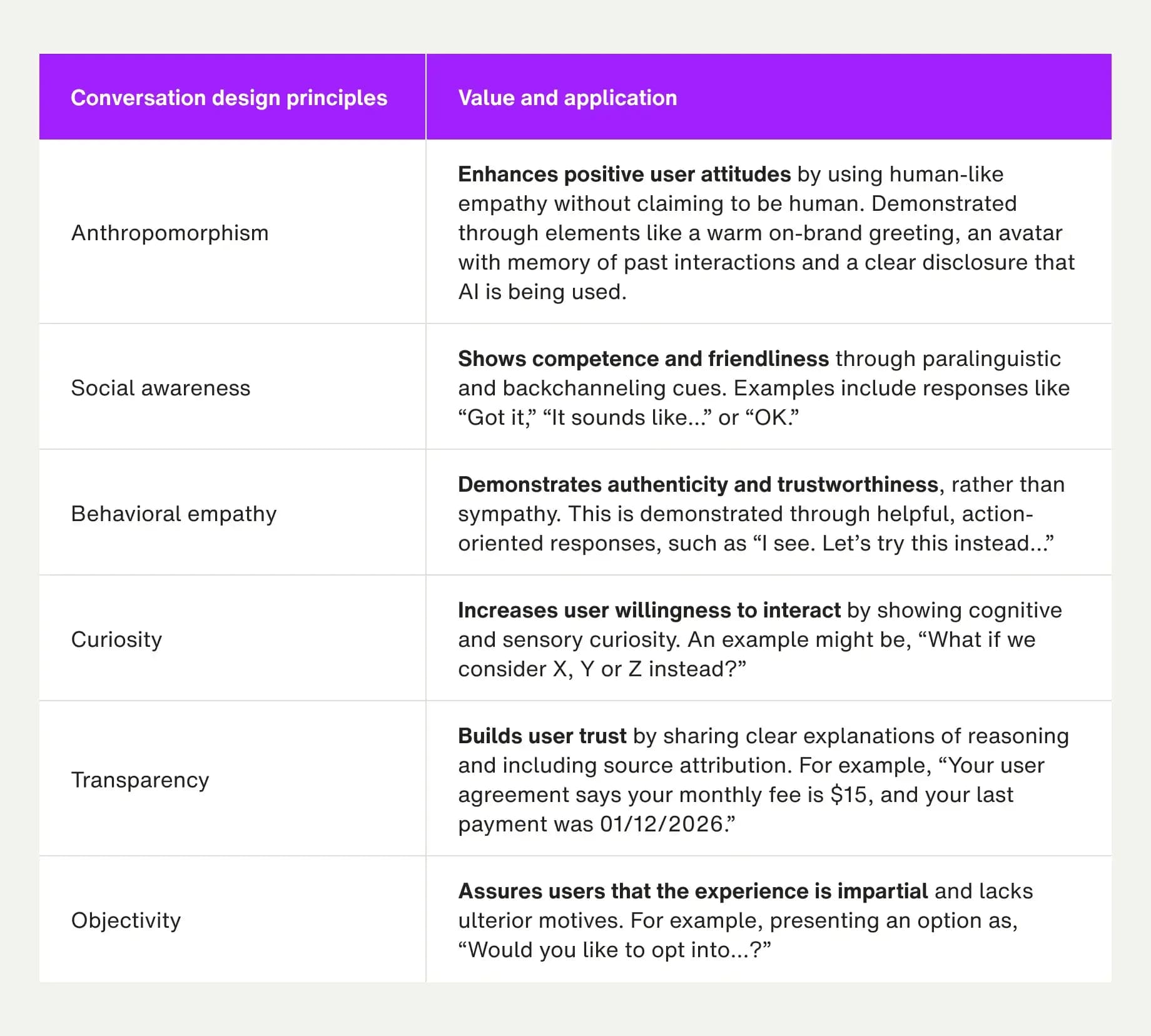
Then, using system prompt engineering techniques such as few-shot prompting and prototyping via Cursor, we implemented brand voice guidelines to guide the chatbot’s behavior.
Today, with a conversational platform that engages CRAs during onboarding and supports them with ongoing knowledge sharing, turnover rates are falling, bringing stability and predictability to our client’s staffing operations.
2. Build a conversational evaluation process powered by human-in-the-loop review
Ideally, conversation design happens through the intentional, deeply researched analysis of real human interactions with computers. But this approach isn’t realistic for many projects because manual review is too inefficient. However, fully automating the evaluation process isn’t a solution either because it creates too much risk.
Take a recent project where we helped a leading global technology company stress-test its AI agent-creation platform. Doing so meant rapidly developing more than 20 cross-industry AI agents along with 50–100 complex, multi-turn conversation transcripts for each agent.
To assess platform performance, we piloted an evaluation process that automatically pulled insights from the AI agents’ orchestration layer (i.e., the layer that tells us how well an agent interprets a user’s request and calls on the appropriate tools). This powered human-in-the-loop review by identifying and prioritizing performance insights that required manual intervention.
The five-part evaluation process included:
- Agent blueprint: We began with deep interviews with actual users to capture their needs and profession-specific vocabulary. This information was consolidated into an agent blueprint — a comprehensive guide for deploying an AI agent.
- Synthetic users: We then used an LLM to create research-backed synthetic users with specific personas and goals (e.g., a kindergarten teacher planning a counting lesson, a supply chain inventory analyst monitoring product levels at a retail warehouse).
- High-volume interaction: The synthetic users had at least 100 conversations with the AI agents, creating realistic interactions for evaluation.
- LLM-as-a-Judge: A second LLM evaluated and scored the synthetic users’ end of the conversation and the agents’ part, looking for adherence to persona and conversational logic.
- Final review and report: A third LLM reviewed all metrics against the conversation transcript to determine whether the conversation passed. This process caught issues and surfaced them for human-in-the-loop review, such as synthetic users not ending conversations at an appropriate time.
Now, our client has a proof-of-concept process that it can scale to rapidly test the robustness of new agent capabilities.
3. Create moments of delight with conversation mapping
Successful conversational design wins the moments that matter by anticipating and surpassing user needs. But as tools like chatbots become standard — more than 90% of financial services companies are either assessing AI or already using it — the harder it is to stand out. Doing so requires a service-first approach that harmonizes business goals with engaging conversational experiences.
We recently collaborated with a major North American bank to transform routine banking into a proactive, delightful experience using Apple Intelligence and Siri. The challenge: Balance the bank's business goals (i.e., introduce upsell opportunities through offers relevant to customers’ voice inquiries) with users’ desire for a frictionless conversational experience.
We focused on solving customers’ most common banking problems first, so that they would be more receptive to the bank's offers and promotions. Some common use cases include:
- Inquiring about account balances (e.g., checking, savings, retirement)
- Performing quick account actions (e.g., scheduling a payment, transferring funds)
- Discovering relevant, personalized offers (e.g., credit cards, budget tools, rewards) positioned as a secondary, valued-added experience that users could easily opt out of
To evolve from an everyday chatbot to an agentic experience, we used conversation mapping. The goal of conversation mapping isn’t to plot “if-then” conversation logic. Rather, it’s to power understanding and personalize responses to each individual user. Consider all the ways a person might ask to check their account balance:
- “What’s my current account balance?”
- “How much is in my travel fund?
- “What is my grocery budget this month?”
These conversational maps allow the AI to provide a direct answer first, fulfilling the user's primary intent. Only after that need is met does the system introduce an upsell opportunity — a point where a core tenet of conversation design, user agency, comes into conflict with the business goal of driving offers.
To navigate this, we prioritize the user's right to opt out. For example, after Siri provides a balance, it might suggest a homescreen widget for at-a-glance access or a personalized, pre-qualified loan offer based on users’ spending patterns, which they can choose to explore further in their banking app or decline by saying or tapping no.
By building clear opt-out paths that ensure the user is always in control, these offers feel like helpful collaboration rather than intrusion. Apple Intelligence reinforces this experience by recognizing context — like a text about rent being due — and proactively offering to schedule a payment, autonomously meeting the user's needs before they even have to ask.
“Creating a conversation is relatively simple because it's something we do every day. But designing a natural digital interaction is a complex puzzle that never really gets solved. It’s not just about a user asking, ‘What's my balance?’ It’s about accounting for nicknames, multiple account types and varied phrasing. Our goal is to fit enough of those linguistic puzzle pieces together so AI gets the picture and responds with clear, helpful and personalized responses,” Moriah Cason, senior content designer at TELUS Digital, says.
4. Prioritize neurodiversity in your conversation design
Designing for a neurodiverse audience results in a best-in-class experience for all. Approximately 15–20% of the global population is neurodivergent, likely a conservative estimate considering how many people don’t know they’re neurodiverse or don’t want to be identified as such. This means neurodivergent users aren’t an edge case. They’re a priority audience.
This best practice emerged from our bot consulting practice. In helping clients design conversational experiences for the neurodiverse, our research found we need to prioritize:
- Reducing users’ cognitive loads
- Removing or limiting time-based challenges
- Avoiding distractions to focus users’ attention
- Favoring task completion over multi-step wandering
- Simplifying conversation flows as much as possible
If those seem like best practices for all audiences, that’s because they are. The more screens and steps involved (e.g., chat › SMS › web verification › document download › rejoining chat), the more likely a user, whether agent or customer, will become distracted and frustrated.
Knowing that helps you identify solutions that simplify your conversational flows. For instance, sending a checklist directly within a chat as formatted text eliminates steps and device switching, reducing the risk of user dropout.
Furthermore, designing for the neurodiverse sharpens your sensitivity to other audiences. Consider how words differ regionally (e.g., mobile versus cell phone, buggy versus shopping cart, fixing versus preparing), or the impact of culture. One audience might appreciate being offered a gift card or account credit, while another would find it insulting.
“It’s easy to get so focused on messaging that the conversation gets forgotten,” James Cornford, staff content designer at TELUS Digital, says. “We always have to come back to the experience the user has on their device, and constantly reassess what we think of as an edge case, not letting subconscious bias cloud that judgment. There are so many things that impact the language someone uses: age, background, education level or even mood.”
This knowledge powers systems that recognize synonyms, spelling variations and colloquialisms as well as intent and cultural context. Doing so powers agentic conversations that seamlessly meet the needs of a global audience.
The future of conversation design: The road to agentic
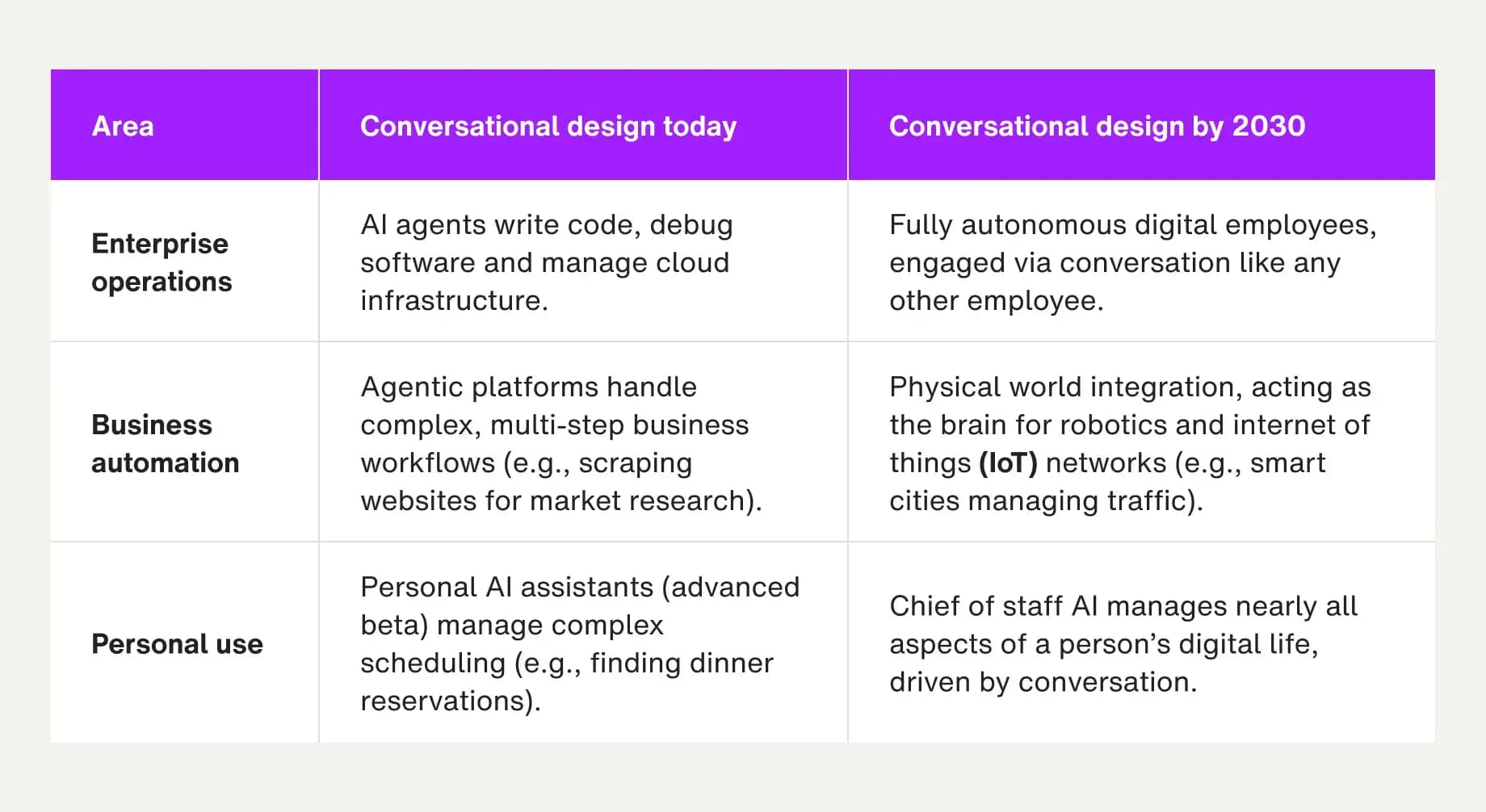
In the next few years, most companies will focus on updating their legacy conversational experiences and begin experimenting with new multimodal interfaces that combine voice, text and touch. However, with the rapid adoption of agentic AI, agentic conversations will likely predominate in brands’ voice strategies as soon as 2030.
Master the conversation: Start your journey to agentic AI
The transition from rules-based interactions to agentic collaboration isn't just a technical upgrade — it’s a total shift in how your brand lives and breathes in the digital world. As we’ve seen, the companies that will lead the next decade are those that recognize conversation design as a core business strategy, not a peripheral UX task.
At TELUS Digital, we go beyond interfaces to help you architect the conversational flows that turn complex AI capabilities into clear, empathetic customer experiences. From automating human-in-the-loop evaluation at scale to readying your infrastructure for a multimodal, agentic future, you don't have to build it alone.
Get started by exploring our Intelligent Conversational AI Solutions.